
FNPF Sea Turtle Saver monitoring program on Nusa Penida
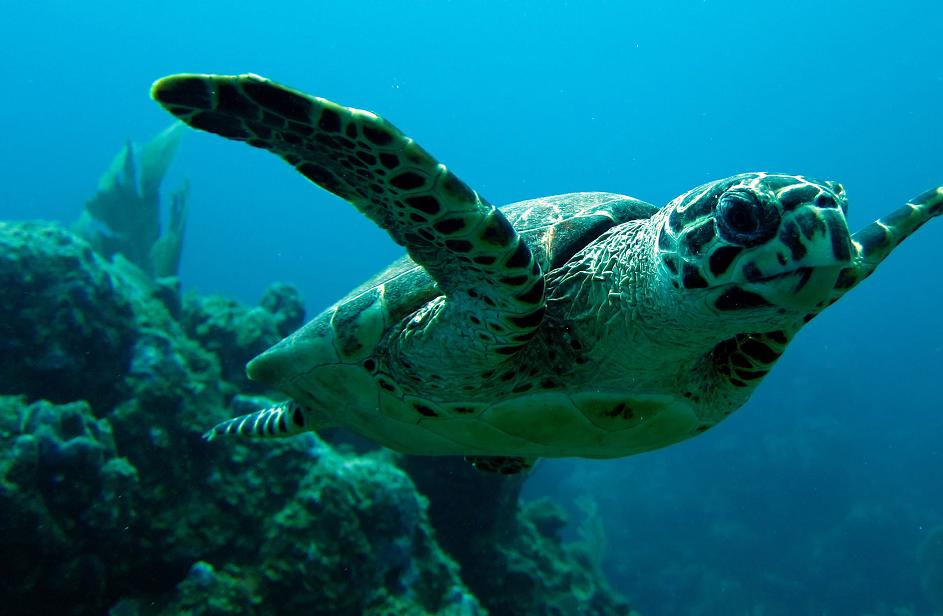
FNPF Sea Turtle Saver monitoring program – at Atuh Beach, on the south-east coast of Nusa Penida – assists the island’s villagers to protect Critically-endangered Hawksbill and endangered Green turtles known to return annually from migration zones to nest at this beach.
Protected now by law, administered under the recent declaration of a Marine Protected Area (June 2014) covering Nusa Penida islands group – the nesting sites at Atuh Beach are checked regularly for any signs of these endangered marine turtle species by staff and volunteers at the FNPF Sea Turtle Monitoring Station.
Saving sea turtles
Funded by Seacology – a US-based non-profit supporting Small-islands Threatened Ecosystems – the FNPF Sea Turtle Saver Monitoring Station was opened in 2013. Patrols are conducted regularly during full-moon nesting cycles – particularly in the months of June and July anticipated to be high season for turtle nesting. To date, there is little recent evidence of sea turtles sightings or nests.
On Nusa Penida, the coastline is fringed by seaweed farms that create access barriers to beaches and make it difficult for marine turtles to navigate to their annual nesting sites. Sea turtles will usually return faithfully to the same nesting site each season after swimming for hundreds or even thousands of kilometres to reach the nesting beach.
Decreasing numbers of sea turtles and turtle sightings may be the result of fishing activity along migratory sea routes. The FNPF Sea Turtle Monitoring Station was sited at Atuh Beach in anticipation of observation and protection for any turtles returning to nest.
While there is strong anecdotal evidence of turtles using this beach as a nesting site in the past, reliable scientific data about numbers of turtles and turtle species is still missing. Monitoring will provide information of turtle species returning to nest on the beach, while protecting natural nests against predators such as monitor lizards, birds, crabs. This will result in increasing numbers of turtle hatchlings and their initial survival rate.
FNPF will provide a professional and specially adapted education program to train selected members of the community to run the turtle monitoring and beach protection. FNPF has considerable experience in turtle protection in Kalimantan, where it mobilized a local community to successfully protect a known turtle nesting beach from predators such as dogs and wild pigs.
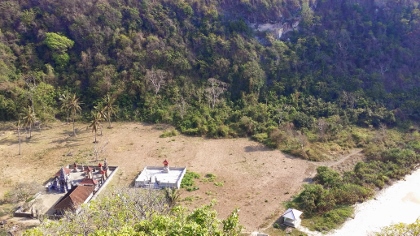
FNPF Sea Turtle Saver monitoring station, Atuh Beach
Thank you Seacology for your generous support!
Mangrove Habitat Restoration
FNPF is planning for future reforestation of mangroves on Nusa Penida, cleared by human activity, as a primordial complement in the process of the sea turtle conservation.
Mangroves are well known for their high biological productivity and their consequent importance to the nutrient budget of adjacent coastal waters. They export organic matter, mainly in detritus form (leaf litter) to the marine environment, thus providing a highly nutritious food source for marine ecosystems. Apart from nutrient export, mangroves also contribute to offshore fisheries by hosting marine nurseries and shelters for many species.
At Atuh Beach – one of the last remaining beaches on Nusa Penida and the surrounding islands that sea turtles can access is a remote stretch of sand, near a remote village. Like all villages on Nusa Penida, the village passed a traditional regulation to protect the birds. But they have now also agreed with FNPF to extend this traditional regulation to protect sea turtles, and wish to work with FNPF to also restore coastal mangroves forests.
New! Nusa Penida Marine Protected Area
Centred between Bali and Lombok, on the Wallace Line – an evolutionary marker that separates the main fauna species of Indo-Malaya and Australo-Papua – Nusa Penida is central to the species division, with the exception of the rebellious Crab-eating macaque.
Nusa Penida islands were officially declared a Marine Protected Area in June 2014. Known for spectacular coral reefs, the Nusa Penida MPA is also home to several important marine wildlife species – the Critically-endangered Hawksbill turtle, the endangered Green turtle, and giants of the sea Manta rays and Ocean sunfish.
FNPF Sea Turtle Monitoring program at Atuh Beach on the east coast of Nusa Penida assists villagers in protecting the Critically Endangered Hawksbill and endangered Green turtles known to nest there. Protected by law, the site is checked regularly for any signs of these endangered marine turtle species.
Interestingly, the world’s heaviest bony fish, the giant-sized Ocean Sunfish – or Mola Mola – (more commonly found in Mediterranean, African and Californian coastlines) is also found in the waters around Nusa Penida islands group and be viewed while snorkelling, diving or from the jetty at Nusa Penida’s main port harbour. Nusa Penida is of the few habitats of Ocean Sunfish in Indonesia and are important for maintaining jellyfish populations.
The Giant manta is also a highlight of Nusa Penida MPA. The graceful Manta alfredi is found in isolated coves and small colonies can be seen from cliff tops, feeding at the sea surface, on rich zooplankton brought in by strong, open ocean currents. The Giant manta is listed by IUCN as Vulnerable with an elevated risk of extinction.
Updated 28 June 2018


